Skip to content

ACTIVITY 9: Conflict – Learning to Deal with It

ACTIVITY 9: Conflict – Learning to Deal with It

CONFLICT - LEARNING TO DEAL WITH IT

Think about it

  • The person sitting in front of you at the movie theater is too tall for you to see around but he doesn’t want to sit anywhere else.
  • You want Italian food, and your sister wants Chinese food.
  • You are invited to two parties at the same time on the same day.
  • You and your best friend are competing for the same position on the soccer team.
Any of these situations could be classified as conflict. A conflict might be defined as a clash between people, ideas, or interests. It does not have to be violent or a bad situation.

ACTIVITY 9: My Perception!

ACTIVITY 9: My Perception!

MY PERCEPTION!

ACTIVITY 9: What I See In Me

ACTIVITY 9: What I See In Me

WHAT I SEE IN ME

What you think about yourself is really important. It can affect how you act and how others see you. Take this survey to think about what you think of you.

ACTIVITY 9: What I See In Me

ACTIVITY 9: What I See In Me

How I Am (Intrapersonal Skills)

This section has students look at how they act, feel, and think. Topics covered include self-esteem, social image, decision-making skills, and personal values (what is important to each student). The activities are designed to provide students with a chance to practice decision making and to empower them to make healthy choices.

SKILLS

SKILLS: Building Self-Esteem / Understanding Personal Values

Suggested Time Consideration

Suggested Time Consideration: 25 mins

RATIONALE

As noted in Activity One, researchers have found that low self-esteem is a strong influential factor in the decision to experiment with tobacco or nicotine. This activity will give students the opportunity to consider and reflect upon their own self-esteem.

GETTING STARTED

Share the digital activity link below with your students. Then, explain to them that self-esteem is a term that describes how we see ourselves, and how we either do or don’t accept ourselves as we are.

LAUNCH ACTIVITY

The statements in the chart come in three clusters:

  • 1 through 4 are related to self-image
  • 5 through 10 are related to how the student wants to be perceived by others and what role peer pressure might play in his or her life
  • 11 through 14 target broad issues of self-acceptance

Ask students to give careful thought to each statement, and then move the statement to the category that best applies(“Agree” or “Disagree”).

Explain to students that the responses they give might be different today than they were six months ago or might be different six months from now. You might help them out by offering some concrete examples. For instance, for number 7, set up a scenario in which a young person has moved to a new town in the middle of the school year. How hard will it be for that person to make new friends? Ask students why some students will find it difficult, and others will not.

TALKING ABOUT IT

After students have completed the survey, give them time to reflect on their responses and then open up the class for discussion. Acknowledge how difficult it can be to discuss these sorts of issues openly and reinforce honesty and forthrightness as they open up about these sensitive issues. Ask your students to consider the following:

  • Did you have trouble deciding on any of the statements?
  • Can you come up with specific examples from your own life that relate to some of the statements?
  • Can you share examples of how you have changed certain behaviors or self-perceptions to feel good about yourself?

Next, have students look at their completed activities to see if they selected “Disagree” for any statement in 1 through 4,or 10 through 14. Likewise, did they “Agree” with any statement in 5 through 9?If so, open the discussion to talk about things they might be able to do to “switch categories.” For example, if it’s hard for them to meet new people, what could they do to become more comfortable with it? They could hang around with a friend who is more outgoing than they are so that they meet new people with the friend.
Emphasize to students that lots of people have something about themselves that they would like to change. Maybe they wish they were less shy, better at sports, better singers, etc.

Ask your students if they think some people believe using tobacco (smoking) or nicotine (vaping) will make them feel better about themselves. Explain that some young people who experiment with tobacco and nicotine do so because they have a low self-image, or they don’t feel good about themselves.1 Explain that this is not a healthy choice to make to feel better about yourself. Discuss alternative, positive choices people their age could make to feel better about themselves.

WRAPPING UP

When you want to bring the conversation to a close, emphasize how all people have things about themselves they feel good about and things they want to change. Stress the fact that the students may have more power to make positive changes than they realize.

SOURCES

1 CDC. Smoking & Tobacco Use. Fact Sheet—Youth and Tobacco Use: Estimates of Current Tobacco Use Among Youth. Referenced 2024. www.cdc.gov/tobacco/data_statistics/fact_sheets/youth_data/tobacco_use/

LAUNCH ACTIVITY

GO!

ACTIVITY 9: My Perception!

ACTIVITY 9: My Perception!

How I Am (Intrapersonal Skills)

This section has students look at how they act, feel, and think. Topics covered include self-esteem, social image, decision-making skills, and personal values (what is important to each student). The activities are designed to provide students with a chance to practice decision making and to empower them to make healthy choices.

SKILLS

SKILLS: Building Self-Esteem / Understanding Personal Values

Suggested Time Consideration

Suggested Time Consideration: 25 mins

RATIONALE

One predictor in the experimentation and escalation phases of tobacco and nicotine uptake is self-image—some adolescents turn to smoking or vaping because they think it will give them a better image.4 Low self-esteem is another factor that influences a young person’s decision to use tobacco and nicotine.

GETTING STARTED

To start this activity, ask students to brainstorm words or phrases that come to mind when they think of people using tobacco or nicotine. Explain that youth smoking rates among middle and high school students have declined over the past decade, but e-cigarette use is on the rise.5

When a comment reflecting the perception that smoking or vaping makes people look “cool” is raised, challenge students to explain why. Ask them to provide specific instances to support their notion that it looks cool. Chances are that any student thinking it looks cool will point to media representation. Ask these students:

Would the person be cool even if he or she did not smoke or vape?

What other characteristics make the person cool?

Do characters tend to hold cigarettes or vapes more often than smoke them? (It may be more common to see them holding cigarettes or vapes than inhaling or spitting tobacco, since these actions are usually less appealing to see.)

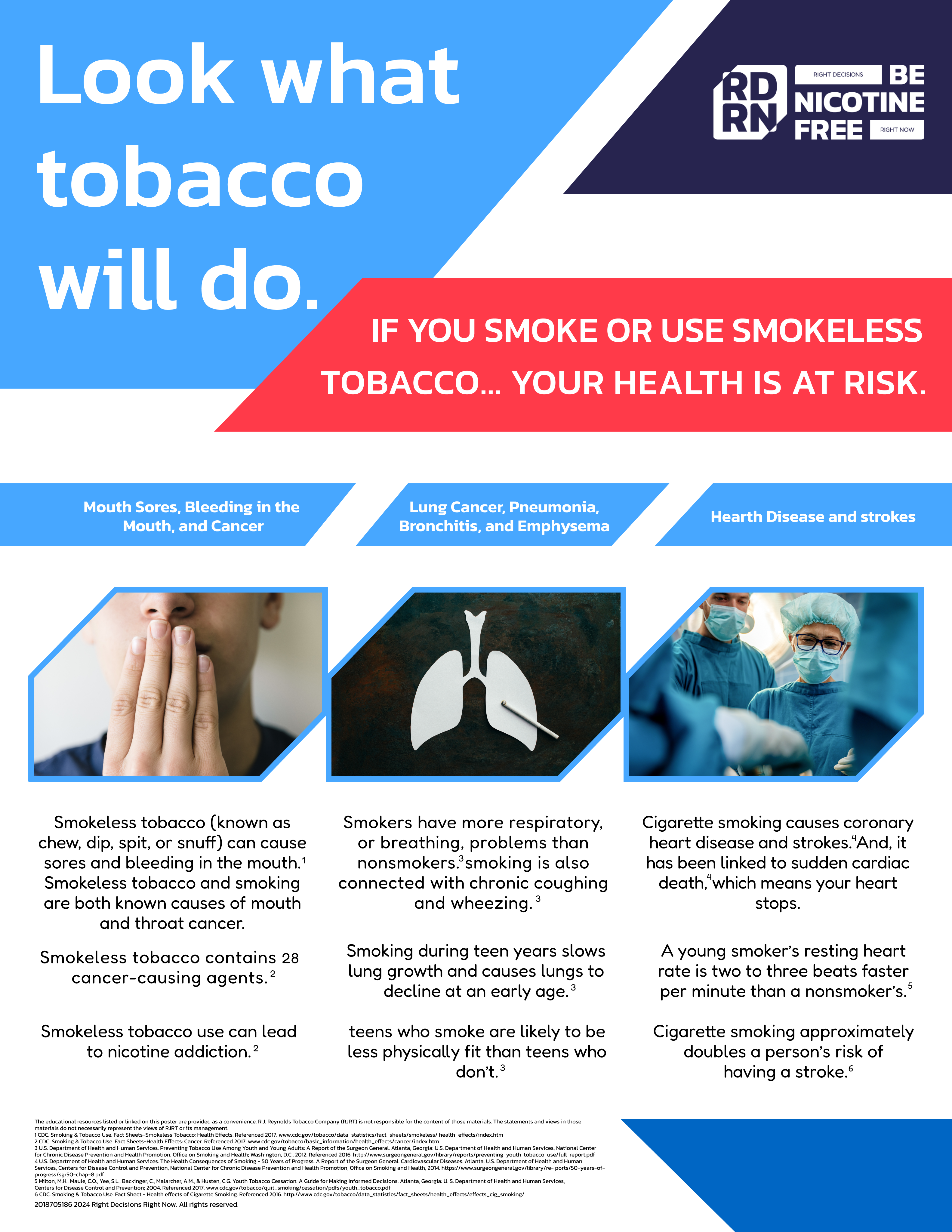
Spend time discussing how important “image” should be, especially when there is a difference between image and reality. Remind students of the health consequences of tobacco and nicotine use, and show them the poster with the images depicting these health issues. The poster is included in the “Activity Resources” section. There is nothing cool about these pictures.

For additional resources related to media representation, see the resource section in the Overview Booklet.

In this exercise, students will examine how they see themselves and the image that they want to portray. Share the digital activity link. Students will select and/or type 10 adjectives that they feel are self-descriptive. Then, they will look at an illustration of young people using tobacco and nicotine and select and/or type adjectives to describe their perception of the characters.

LAUNCH ACTIVITY
TALKING ABOUT IT

Once their lists are completed, students should compare them. Create two columns on the board with the headers “Us” and “The Characters.” Ask for volunteers to share adjectives and write them under each column. If you feel your students might be reticent to share their lists, you can suggest adjectives for the “Us” column.

Remind students that perceptions are subjective. Encourage them to talk about what they might have learned about themselves and about how others see them. Then move the conversation in the direction of what constitutes a positive self-image and raise the issue of how some people begin using tobacco or nicotine simply because of how they think it makes them look.

WRAPPING UP

Refer back to the words on the board. If your students have a positive perception of the characters in the illustration, ask them to explain why. See if some students a) think it looks cool to smoke/vape, b) think it looks cool but isn’t worth the risk, or c) think it looks ridiculous. Try to bring the conversation around to a discussion of how, when it comes to tobacco and nicotine, there aren’t any “positive” images.

To emphasize the point, display the poster depicting the health consequences of tobacco and nicotine use. Refer to the list of words and tell students, “Keep in mind that the pictures and facts on the poster are reality.”

SOURCES

4 U.S. Department of Health and Human Services. Preventing Tobacco Use Among Youth and Young Adults: A Report of the Surgeon General. Atlanta, Georgia: U.S. Department of Health and Human Services, National Center for Chronic Disease Prevention and Health Promotion, Office on Smoking and Health; Washington, D.C., 2012. Referenced 2023. http://www.surgeongeneral.gov/library/reports/preventing-youth-tobacco-use/full-report.pdf 

5 https://www.cdc.gov/tobacco/data_statistics/fact_sheets/fast_facts/trends-in-tobacco-use-among-youth.html

LAUNCH ACTIVITY

GO!

ACTIVITY 9: Conflict – Learning to Deal with It

ACTIVITY 9: Conflict – Learning to Deal with It

How I Am (Intrapersonal Skills)

This section has students look at how they act, feel, and think. Topics covered include self-esteem, social image, decision-making skills, and personal values (what is important to each student). The activities are designed to provide students with a chance to practice decision making and to empower them to make healthy choices.

SKILLS

SKILLS: Conflict Management

Suggested Time Consideration

Suggested Time Consideration: 30 mins

RATIONALE

Students might have conflicts with their parents, siblings, friends, or even internal conflicts with themselves. Internal conflicts your students experience may be the result of peer pressure and peer influence – or just wanting to fit in.

GETTING STARTED

Begin this activity by brainstorming with your students about what they think of when they hear the word “conflict.” Write their answers on the board. If there are only negative answers, ask students to consider whether having tickets to two events on the same night is a conflict. It is, but it is not necessarily negative.

Explain to students that some conflicts can involve other people, such as a disagreement with your parents about your curfew; while others can be internal, such as feeling conflicted about how you want to settle a misunderstanding with a friend.

Share the digital activity link and go over the tips for conflict resolution with your students. You may wish to walk through the activity together by presenting it on an interactive whiteboard. Have students take turns reading the conflict resolution tips aloud.

LAUNCH ACTIVITY
TALKING ABOUT IT

Open the class for discussion and have students talk about how they would manage each conflict presented in the first four “You Decide!” situations.

Then, ask students:

  • What kind of conflicts might students encounter related to tobacco and nicotine? (Students might feel pressured by friends to use tobacco and nicotine. It can also cause a conflict between friends. It can also cause an internal conflict as the student being pressured tries to figure out how to handle his or her friends.)
  • What are some ways you could handle conflict if you were in this type of situation?
  • How could you handle your friends?
  • What can you to do to make yourself feel better if you have a conflict with a friend? (Encourage students to keep in mind their goals and what’s important to them if they have a conflict with a friend. For example, they should remind themselves why they chose to be tobacco and nicotine free and focus on that while they resolve the conflict with their friend.)

Have students role-play the situation in Scenario 5. Then, ask the class to discuss the skits by focusing on the questions above.

In discussions with students, encourage them to be imaginative in devising positive resolutions to conflict. Recap what works and what doesn’t work. Discuss the role of anger in an argument and how things like raised voices can impede the resolution of a conflict.

WRAPPING IT UP

Wrap up by pointing out that the existence of conflict is not necessarily a bad thing; two people who work through their conflicts creatively and peacefully are demonstrating just how much their relationship means to them.

LAUNCH ACTIVITY

GO!